Opinion article · Helsingin Sanomat ·
The welfare state is built on sustainable economic growth
Instead of abandoning economic growth, politics should focus on the kind of growth we want.
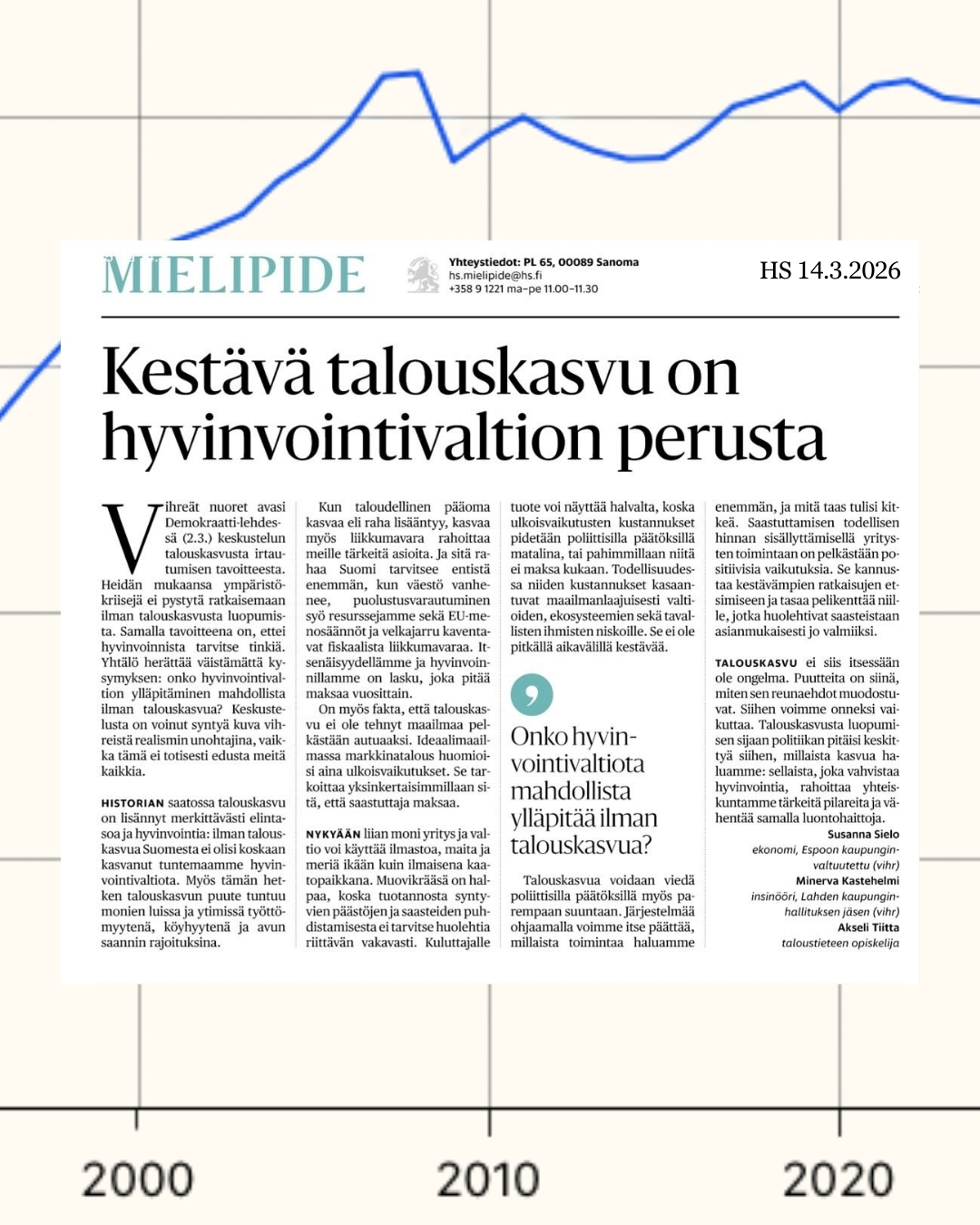
Read the original article in Helsingin Sanomat →
The Greens Youth opened a discussion in Demokraatti on 2 March about moving away from economic growth. They argue that environmental crises cannot be solved without abandoning growth, while also aiming to avoid compromising wellbeing. This inevitably raises the question of whether the welfare state can be maintained without economic growth. The debate may have portrayed the Greens as forgetting reality, but that certainly does not represent all of us.
Throughout history, economic growth has substantially improved living standards and wellbeing. Without it, Finland would never have become the welfare state we know. Today's lack of growth is also felt directly by many through unemployment, poverty and restricted access to help.
When financial capital grows, there is more room to fund what matters to us. Finland needs that money more than ever as the population ages, defence preparedness consumes resources, and EU spending rules and the debt brake narrow fiscal room for manoeuvre. Our independence and wellbeing come with a bill that must be paid every year.
It is also true that economic growth has not made the world universally better. In an ideal world, the market economy would always account for externalities. Put simply, the polluter would pay.
Today, too many companies and states can treat the climate, land and seas as a free dumping ground. Plastic junk is cheap because producers do not have to take sufficient responsibility for cleaning up emissions and pollution. A product may appear cheap because political decisions keep the costs of externalities low, or because nobody pays them at all. In reality, those costs fall on states, ecosystems and ordinary people worldwide. That is not sustainable in the long run.
Can the welfare state be maintained without economic growth?
Political decisions can also steer growth in a better direction. By shaping the system, we can choose which activities to encourage and which to phase out. Making businesses bear the true cost of pollution has positive effects: it encourages sustainable solutions and levels the playing field for those already managing their pollution responsibly.
Economic growth is therefore not itself the problem. The shortcomings lie in the conditions under which it takes place, and fortunately we can change those. Instead of abandoning economic growth, politics should focus on the kind of growth we want: growth that strengthens wellbeing, funds society's essential pillars and reduces harm to nature.
Susanna Sielo
MSc in Economics and Business Administration, Espoo City Councillor (Greens)
Minerva Kastehelmi
engineer, member of Lahti City Board (Greens)
Akseli Tiitta
economics student